
Biography of Vincent Van Gogh
Vincent Van Gogh, one of the greatest artists in history, created around 2,000 artworks during his lifetime. However, his work went largely unrecognized while he was alive, and he lived in poverty.
Born in the Netherlands to a large family, Vincent had strained relationships with most of his relatives. His younger brother, Theo, was his only steadfast support throughout his life.
Van Gogh had a difficult childhood, struggling academically and frequently changing schools. He tried various low-paying jobs before returning to his family home.
Later, he became a preacher, visiting schools, homes, and hospitals. However, his efforts to advocate for workers’ rights were rejected, and he was banned from preaching.

Van Gogh’s career as an artist began in The Hague, where he started experimenting with painting. During this time, he met a pregnant prostitute on the street, whom he took in and eventually grew attached to, along with her children. They became models for some of his works.
He later moved to the Drenthe province in northeastern Netherlands, where he lived among farmers and used them as subjects for his paintings. These works are notable for their use of cool tones.
Afterward, Van Gogh relocated to Antwerp and enrolled in an art school. Despite his teachers’ claims that he had no talent, Van Gogh persisted.
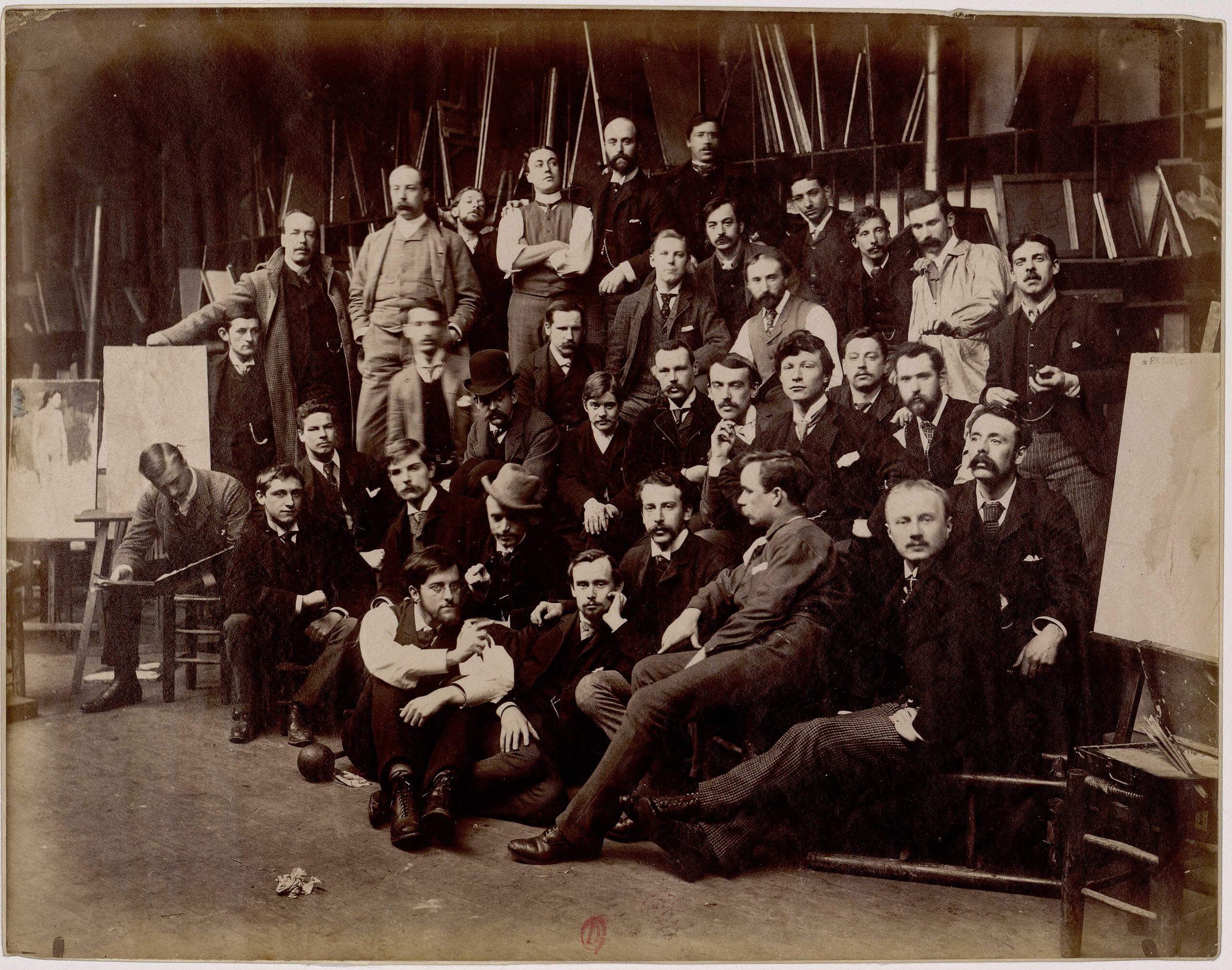
It was here that he began interacting with prominent artists and intellectuals of his time, including Émile Bernard, Henri de Toulouse-Lautrec, Paul Sérusier, Paul Gauguin, and others.
Van Gogh eventually moved to Paris, where he met other well-known artists and began incorporating brighter colors into his works.
This period marked the beginning of a unique artistic style that would later be known as post-impressionism.
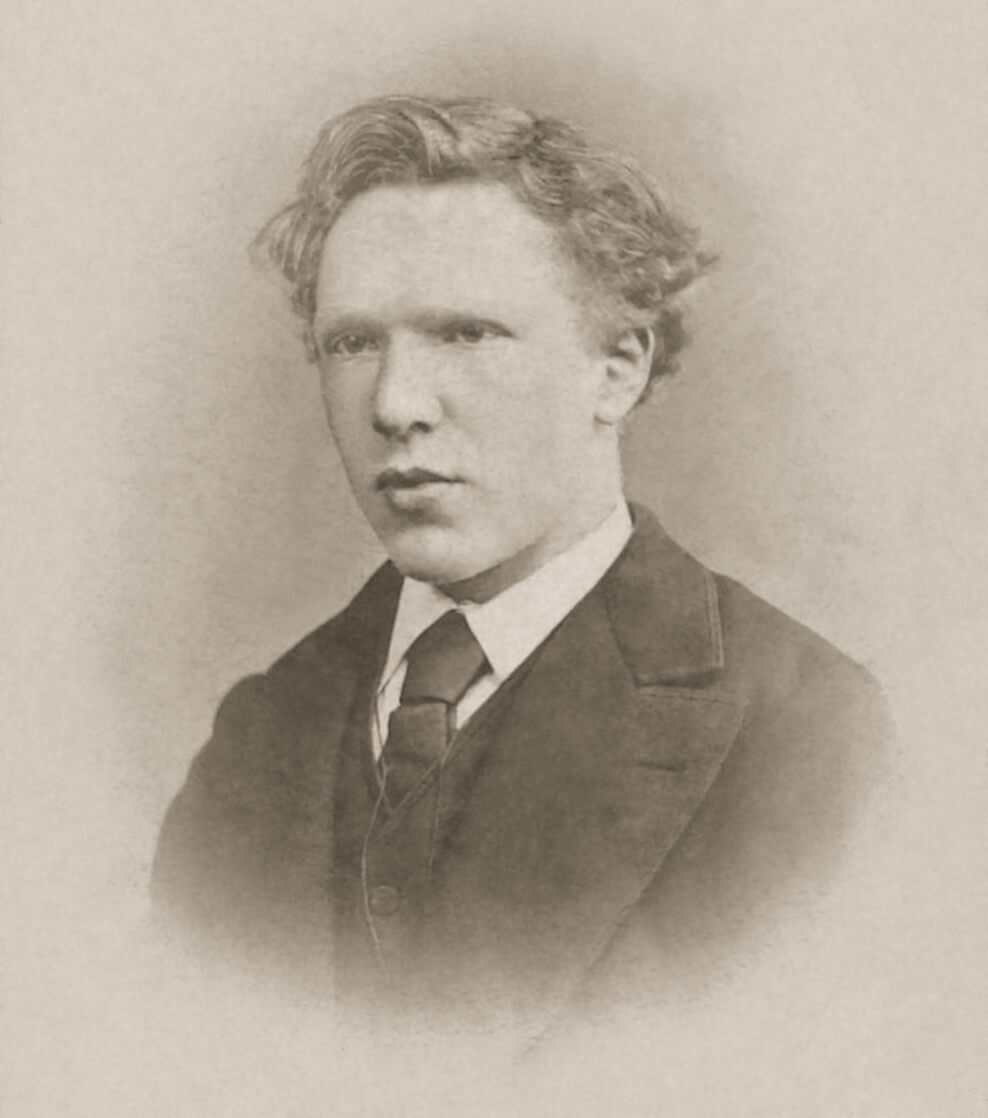
Throughout his life, Vincent maintained an extensive correspondence with his brother Theo, sharing his thoughts on art and his creative process.
Tragically, he sold only one painting during his lifetime, unaware of the immense fame he would achieve posthumously.
The incident of the severed ear
One of the most infamous events in Van Gogh’s life is the incident with his severed ear. Although the exact details remain unclear, the episode is closely tied to his relationship with fellow artist Paul Gauguin.
Van Gogh dreamt of creating an artist community in Arles, in southern France. While he invited several artists, only Gauguin joined him. Initially, the two collaborated peacefully, but tensions eventually flared.
“I well knew that one could break one’s arms and legs before, and that then afterwards that could get better but I didn’t know that one could break one’s brain and that afterwards that got better too”.
Letter to Brother Theo, January 28, 1889
Following a heated argument with Gauguin, Van Gogh experienced a mental breakdown, during which he severed his own ear. This led to his hospitalization and eventual admission to a psychiatric institution, where painting became his only solace.
During this time, Van Gogh produced some of his most famous works, including “The Starry Night” (1889) and “Self-Portrait with Bandaged Ear”.
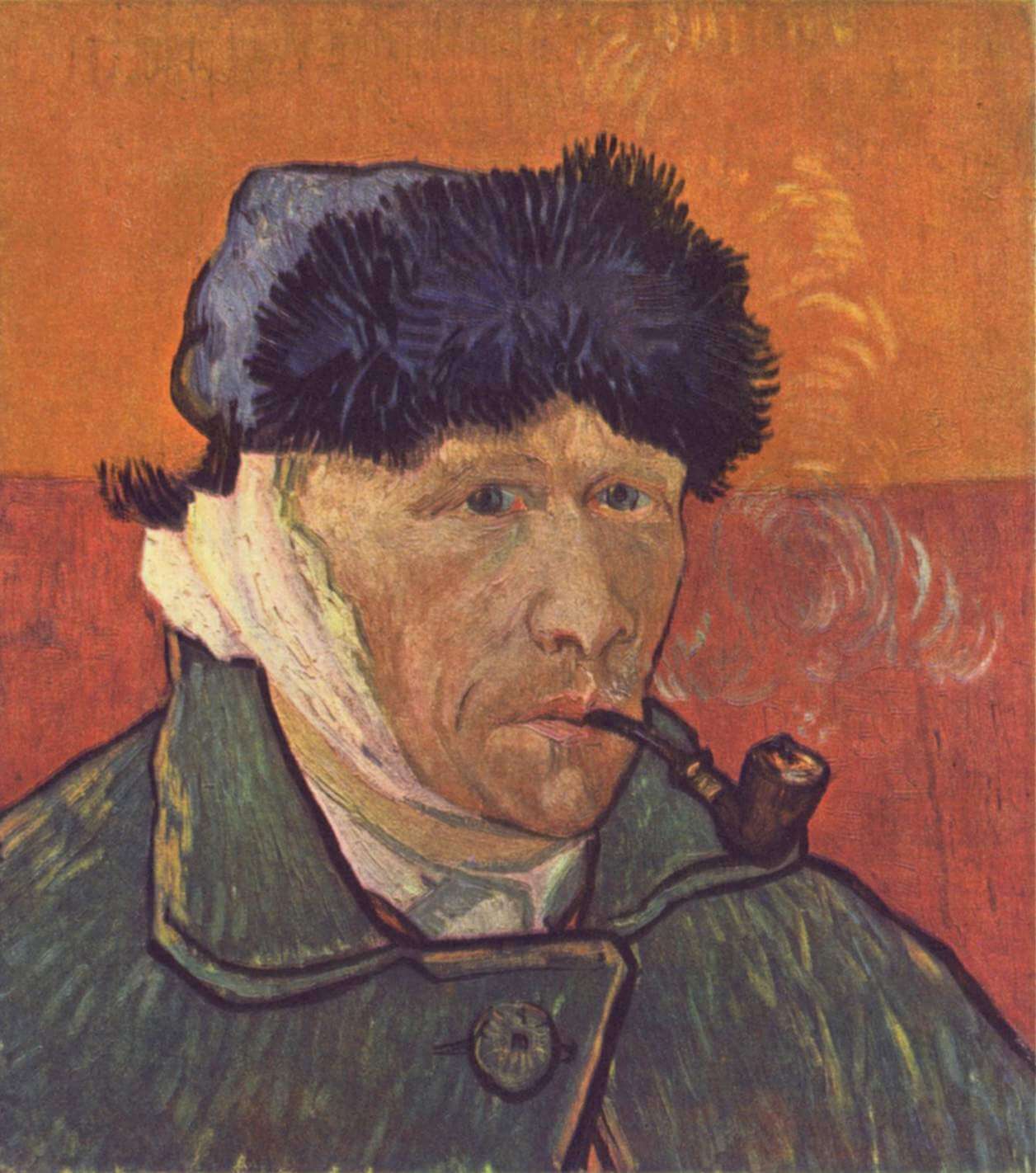
Self-Portrait with Bandaged Ear and Pipe, 1889
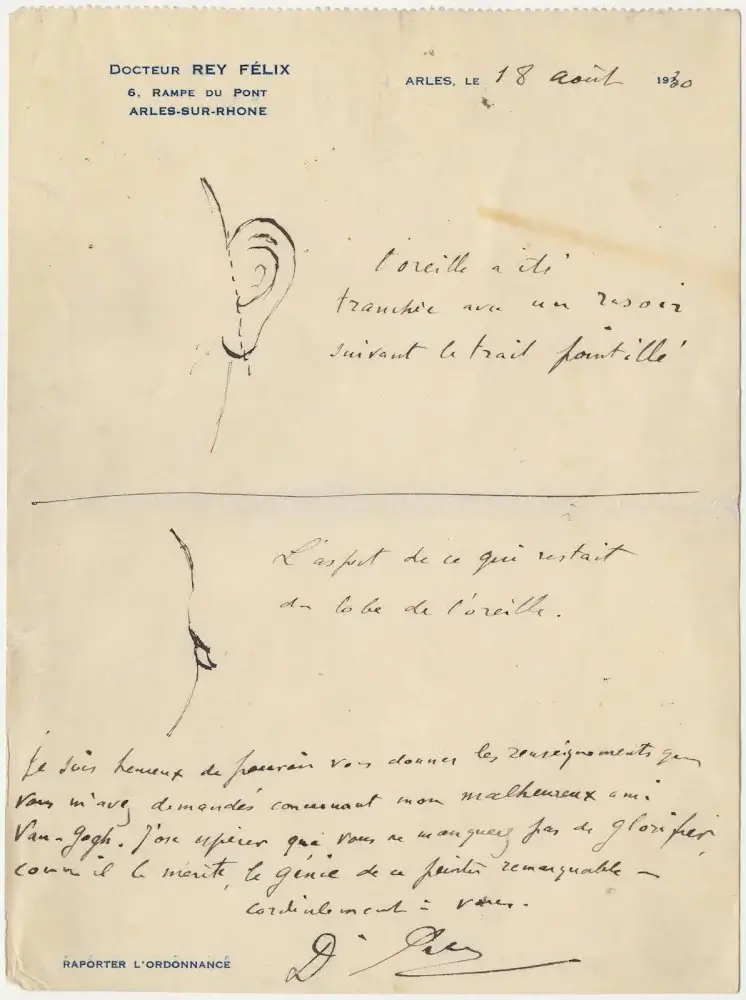
A letter from Dr. Felix Ray with drawings of a mutilated ear
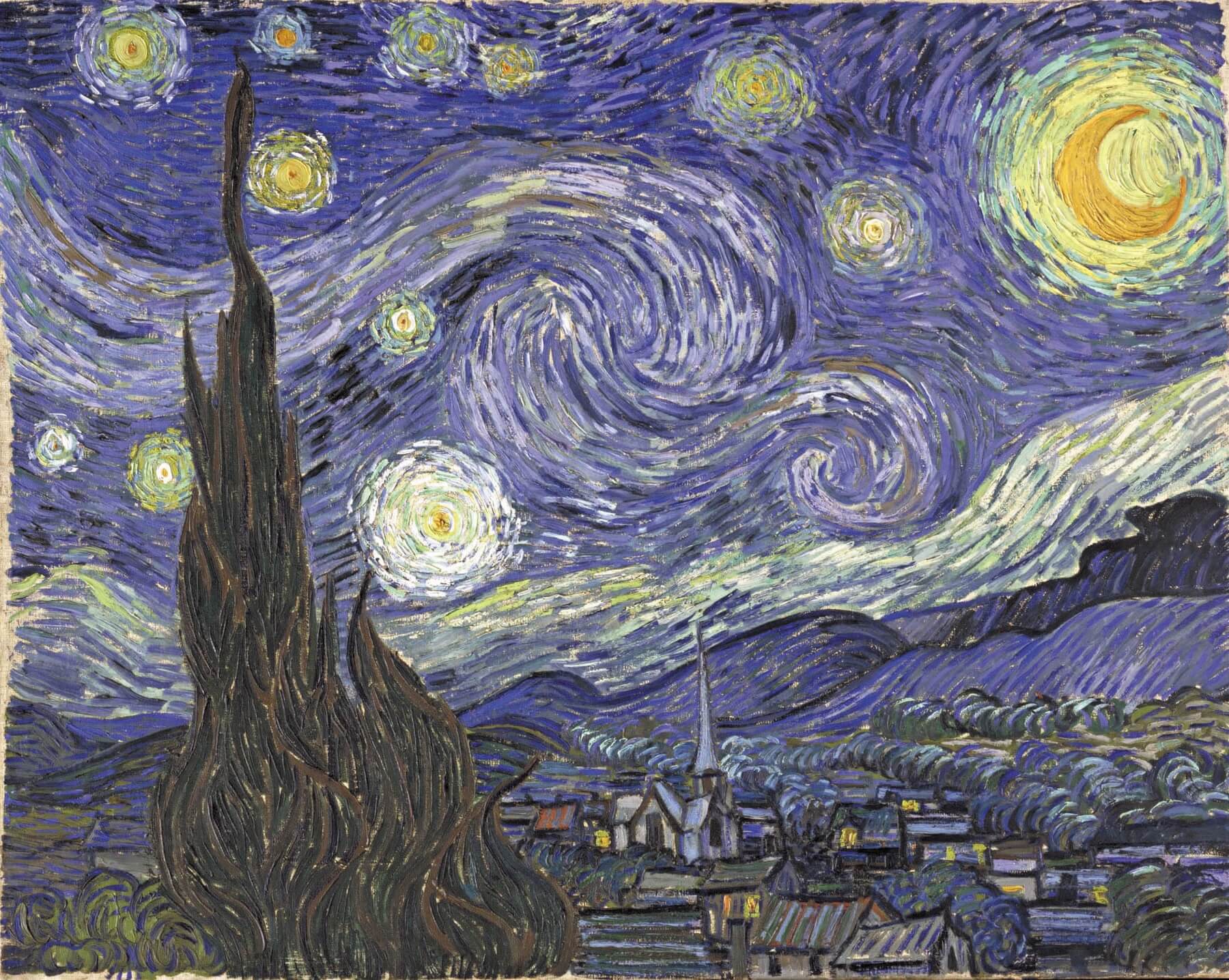
The Starry Night, 1889
Struggles with mental health
Van Gogh suffered from recurring psychotic episodes and mental instability, particularly in his later years. Over 150 psychiatrists have analyzed his condition, proposing over 30 different diagnoses, including schizophrenia, bipolar disorder, epilepsy, lead poisoning, Ménière’s disease, and syphilis.
These conditions were exacerbated by malnutrition, overwork, insomnia, and alcohol dependency—especially absinthe.
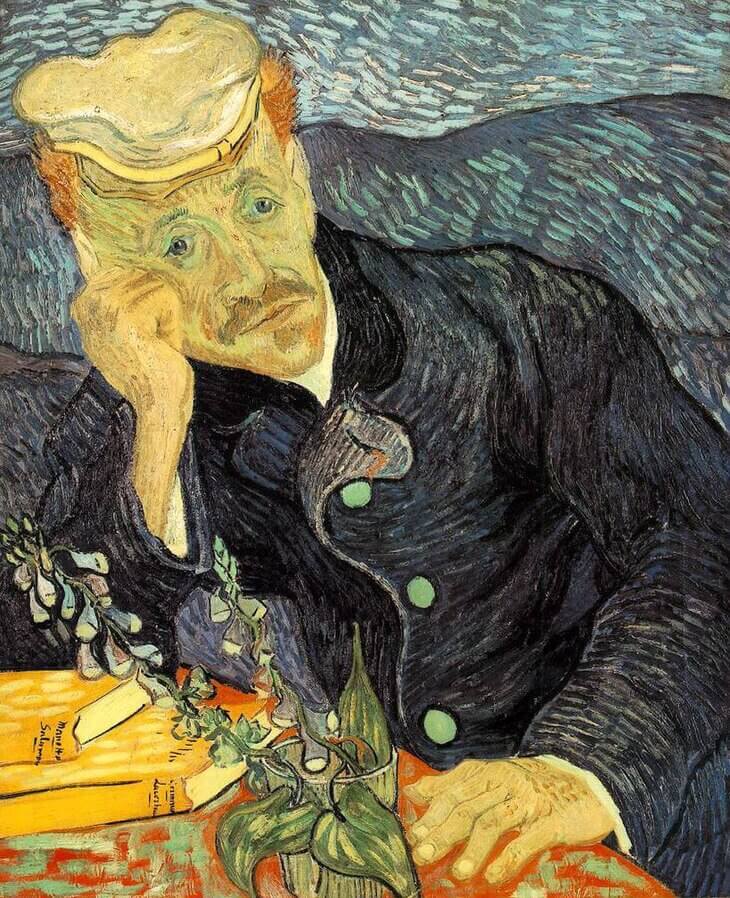
Some theories suggest that Van Gogh’s use of digitalis, prescribed by Dr. Gachet for epilepsy, may have affected his perception of color and light.
However, there is no definitive proof that he consumed the substance, even though Dr. Gachet is depicted in Van Gogh’s “Portrait of Dr. Gachet” holding a branch of the plant.
The tragic death of Vincent Van Gogh
On July 27, 1890, at the age of 37, Van Gogh sustained a gunshot wound to the chest, which is widely believed to have been self-inflicted
The incident likely occurred in a wheat field where he had been painting. Despite the wound, he managed to walk back to his room, where two doctors tended to him.
Theo arrived at his brother’s side the next morning, finding Vincent in good spirits. However, his condition worsened due to infection, and he died 29 hours later on July 29, 1890.
Van Gogh was buried in the municipal cemetery of Auvers-sur-Oise on July 30, 1890.
“The sadness will last forever.”
Vincent’s last words to his brother Theo

Devastated by Vincent’s death, Theo’s health deteriorated rapidly, as he was already suffering from syphilis.
Unable to cope with the loss, Theo died six months later on January 25, 1891, and was initially buried in Utrecht.
In 1914, Theo’s wife, Johanna Van Gogh-Bonger, exhumed his remains and reburied him next to Vincent in Auvers-sur-Oise. Today, their graves stand side by side, a testament to their unbreakable bond.
Alternative Theories About Van Gogh’s Death
In 2011, American art historians Steven Naifeh and Gregory White Smith proposed an alternative theory, suggesting that Van Gogh might have been accidentally shot by local teenagers who frequently spent time with him.
This theory cites testimonies about a boy named René Secretan, who reportedly bullied Van Gogh and may have owned the gun involved.
However, this hypothesis remains controversial, with experts divided on whether the evidence supports suicide or an accidental shooting.
Finally, Rene Secretan, whose American authors claim that the artist made a drawing disguised as a cowboy and who attended Buffalo Bill’s Wild West Show in Paris in early 1890, stole innkeeper Arthur Rava’s revolver to shoot birds and small animals—the revolver responsible for the manslaughter or accidental murder of Vincent Van Gogh..
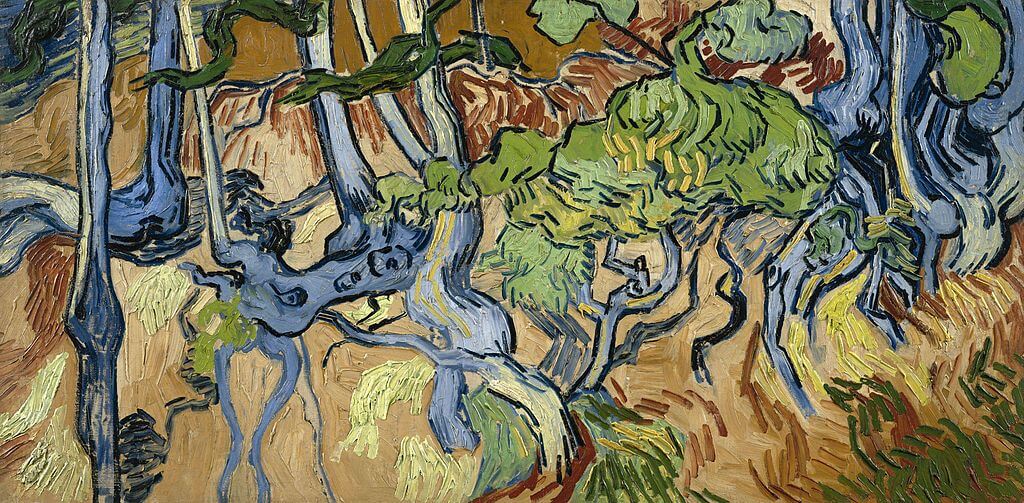
In 2020, researcher Wouter van der Veen analyzed the final days of Van Gogh, including the location where he painted his last work, “Tree Roots”, and his writings, which appear to support the suicide narrative
This thesis of suicide was questioned by pathologist and American expert in the field of forensic medicine Dr. Vincent DiMaio, who adheres to the hypothesis of murder.
The saddest thing is that people like Van Gogh become famous only after death. The artist gave the world 2000 paintings and a new style in art.